
Precice Max (Pmax) Limb Lengthening Surgery in Istanbul, Turkey — by Dr. Huseyin Kavak
+90 539 332 48 68 [email protected] Istanbul, Türkiye

Internal Limb Lengthening Comparison

Precice Max vs Precice 2

Both are fully internal, magnetically controlled limb lengthening nails — but Precice Max introduces meaningful upgrades in strength, weight bearing, and recovery. This guide breaks down every difference to help you make an informed decision.

· Reviewed by Dr. Huseyin Kavak

Quick Summary: What Changed?

Precice 2 has been the gold standard in internal limb lengthening for years — a fully implantable, magnetically controlled titanium nail with no external fixators. It transformed the field by offering patients a far more comfortable alternative to LON and external fixator methods.

Precice Max (Pmax) builds on that same platform but re-engineers the core hardware. The nail wall is thicker, the magnetic motor is stronger, the diameter options are larger (up to 14 mm versus 12.5 mm), and the weight-bearing capacity is significantly improved. It received FDA 510(k) clearance in December 2023.

The short version: if Precice 2 is the proven, reliable choice, Precice Max is the next-generation upgrade — stronger, earlier weight bearing, and improved MRI compatibility. Both are excellent systems. The right choice depends on your body, your goals, and your budget.

Precice Max and Precice 2 intramedullary nail comparison
Precice Max (left) vs Precice 2 (right) — both fully internal lengthening nails

Precice Max vs Precice 2 — Full Comparison

A side-by-side breakdown of every meaningful difference between the two systems.

FeaturePrecice 2Precice Max
System TypeFully internal magnetic nailFully internal magnetic nail
ManufacturerNuVasive / Globus MedicalNuVasive / Globus Medical
FDA ClearanceYes (2013)Yes (December 2023)
Clinical DataExtensive — 10+ years, 1000+ implants globallyLimited — first surgery February 2024
Recall HistoryNoneClass II recall — September 2024 (resolved)
Nail Diameter Options8.5 mm – 12.5 mm10 mm · 11.5 mm · 13 mm · 14 mm
MaterialStainless steelTitanium alloy
Weight BearingPartial — limited throughout lengthening150–250 lbs per leg (varies by nail diameter)
Magnetic MotorStandardStronger & more precise
MRI CompatibilityConditionalImproved
Control MethodERC (External Remote Controller)ERC (External Remote Controller)
External DeviceNoneNone
Infection RiskVery lowVery low
ScarringMinimalMinimal
Lengthening Rate~1 mm per day~1 mm per day
Recovery Duration8–12 months8–12 months
Patient Comfort
CostPremiumPremium+
AvailabilityWidely available globallyLimited — newer system

Key Terms Explained

Intramedullary Nail
A titanium rod implanted inside the bone canal that provides internal support and enables controlled lengthening.
Weight Bearing
The amount of body weight a patient can safely put on the operated leg during the lengthening phase. Higher weight-bearing capacity means earlier mobility.
ERC Device
External Remote Controller — a handheld magnetic device used to activate the internal nail from outside the body, enabling daily bone lengthening without any incision.
Consolidation
The final healing phase where newly formed bone gradually hardens and solidifies, typically lasting 3 to 6 months after the target length is reached.
Dr. Huseyin Kavak consulting with a limb lengthening patient
Dr. Huseyin Kavak during a patient consultation

"I perform both Precice 2 and Precice Max. The right choice is never about which nail is newer — it is about which nail fits the patient. Weight, bone quality, and lifestyle matter more than marketing."

Dr. Huseyin Kavak
Dr. Huseyin Kavak Orthopedic Surgeon · UpRise Clinic

What the Differences Mean for You

The table tells you what changed. This section explains why it matters.

Weight Bearing — The Biggest Practical Difference

Weight bearing is arguably the most impactful upgrade in Precice Max. With Precice 2, patients must follow strict partial weight-bearing protocols throughout the lengthening phase. This means relying heavily on walkers and crutches, with limited ability to put full pressure on the operated leg.

Precice Max's thicker titanium wall and larger diameter (up to 14 mm) allow the nail to tolerate significantly more mechanical load. Patients can transition toward full weight bearing earlier — which means faster rehabilitation, better muscle preservation, and a greater sense of independence during what is already a demanding recovery process. For heavier patients in particular, this is a critical advantage.

Precice Max Nail DiameterWeight Bearing (lbs)Weight Bearing (kg)
10 mm150 lbs68 kg
11.5 mm200 lbs91 kg
13 mm250 lbs113 kg
14 mm250 lbs113 kg

Note: The appropriate nail diameter is determined by the dimensions of the patient's intramedullary canal. Dr. Huseyin Kavak selects the optimal size during your pre-operative evaluation.
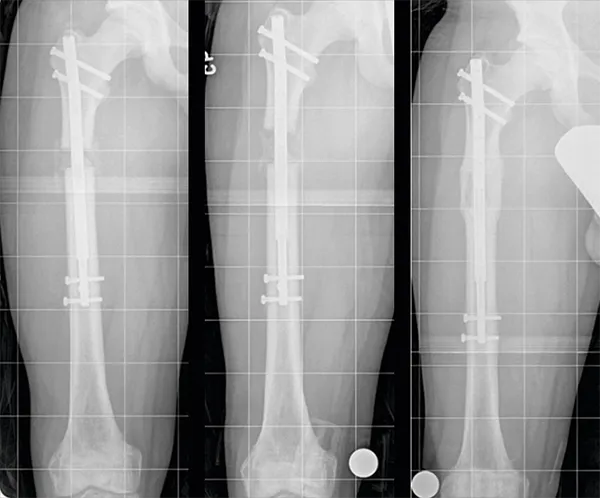
X-ray comparison of internal lengthening nail in femur bone during limb lengthening
X-ray showing an internal lengthening nail during the distraction phase

Comfort & Daily Life

Both Precice 2 and Precice Max are fully internal — no external fixators, no pins through the skin, no visible hardware. In terms of discretion and daily comfort, both systems are in the same category and far superior to LON or Ilizarov methods.

However, Precice Max's improved weight-bearing capacity has a downstream effect on comfort. Patients who can bear more weight earlier tend to sleep better, move more confidently, and experience less overall frustration during the lengthening phase. The difference is not dramatic in the first weeks, but becomes increasingly noticeable as the lengthening progresses.

Material — Stainless Steel vs Titanium

Precice 2 is constructed from stainless steel, a material with a long track record in orthopedic implants. It is strong, cost-effective, and well understood by surgeons worldwide.

Precice Max uses a titanium alloy — a material that offers improved biocompatibility, lighter weight, and greater resistance to corrosion. Titanium is also the reason behind Pmax's improved MRI compatibility, as it produces fewer artifacts on magnetic resonance imaging compared to stainless steel. For patients who may need MRI scans during or after their lengthening treatment, this material change is clinically significant.

Infection Risk & Scarring

Both systems carry a very low infection risk because there are no external pins creating open wound sites. Scarring is also minimal for both — a single small incision near the hip or knee. In these categories, there is no meaningful difference between Precice 2 and Precice Max. Both are excellent.

MRI Compatibility

Precice 2 has conditional MRI compatibility — meaning imaging is possible in certain conditions but with limitations. Precice Max improves on this with an updated design that broadens MRI compatibility. This matters for patients who may need diagnostic imaging for unrelated health conditions while the nail is still implanted, which can be up to 1–2 years post-surgery.

Control Mechanism

Both systems use the same ERC (External Remote Controller) — a handheld magnetic device that activates the internal nail from outside the body. The patient performs three daily sessions, each extending the bone by approximately 0.33 mm. The process is identical for both Precice 2 and Precice Max. However, the stronger magnetic motor in Precice Max delivers more consistent and reliable activation, particularly in patients with more soft tissue between the skin and the nail.

Cost Difference

Precice Max is more expensive than Precice 2. The higher cost reflects the re-engineered titanium construction, stronger motor, and newer manufacturing process. The exact price difference varies by clinic and country.

At UpRise, both methods are available with transparent, all-inclusive pricing. Whether the additional investment in Precice Max is worthwhile depends on your individual priorities — particularly around weight bearing and earlier mobilization. Dr. Huseyin Kavak provides a personalized recommendation during your consultation based on your anatomy, weight, lifestyle, and budget. View our Precice Max cost details.

Availability

Precice 2 has been available globally for over a decade and is offered by limb lengthening surgeons worldwide. Precice Max is significantly newer — FDA-cleared in late 2023 — and availability remains limited. Not all surgeons or clinics have access to the Pmax system yet. At UpRise in Istanbul, Dr. Huseyin Kavak offers both Precice 2 and Precice Max, ensuring patients can access whichever system best suits their needs.

Which System Is Right for You?

There is no single best method — only the best method for your situation. Here is a practical guide.

Choose Precice Max If You…

Want the most advanced internal nail available today
Prioritize earlier weight bearing and faster mobilization
Are a heavier or more physically active patient
May need MRI scans during or after treatment
Are comfortable investing in the premium option

Choose Precice 2 If You…

Want a proven, globally established internal system
Prefer a system backed by over a decade of clinical data
Have a lighter body weight within Precice 2 limits
Want maximum comfort without external fixators
Are looking for a slightly more accessible price point
Dr. Huseyin Kavak - Orthopedic Surgeon and Limb Lengthening Specialist

Dr. Huseyin Kavak

Orthopedic Surgeon

About the Author

Performed by a Specialist You Can Trust

Dr. Huseyin Kavak is an orthopedic surgeon specializing in limb lengthening and deformity correction, with over 500 successful procedures. He serves as a sports physician at Fenerbahce Sports Club — bringing elite-level precision, biomechanical expertise, and a meticulous approach to every patient's journey.

At UpRise, Dr. Huseyin Kavak performs all limb lengthening methods including LON, Precice, Fitbone, and Precice Max — recommending the safest and most effective option based on your individual evaluation.

Learn More About Dr. Huseyin Kavak

Precice Max vs Precice 2 — FAQ

It depends on your priorities. If earlier weight bearing, improved MRI compatibility, and the latest engineering matter to you, the additional investment may be worthwhile. If you are a lighter patient with straightforward lengthening goals and budget is a key factor, Precice 2 remains an excellent and proven choice. Dr. Huseyin Kavak will help you evaluate both options during your consultation.

Precice Max is generally the stronger option for heavier patients. Its thicker titanium wall and larger diameter (up to 14 mm) provide greater mechanical strength, reducing the risk of nail-related complications under higher body weight. For patients above a certain weight threshold, Dr. Kavak may specifically recommend Precice Max for safety and performance reasons.

Yes. At UpRise Clinic in Istanbul, Dr. Kavak performs all major limb lengthening methods including Precice Max, Precice 2, Fitbone, and LON. He does not promote a single system — your recommendation is based entirely on your medical evaluation, body structure, goals, and budget.

The overall recovery timeline is similar — 8 to 12 months from surgery to fully consolidated bone. The key difference is in early recovery: Precice Max patients can typically bear more weight sooner, which can make the first 2 to 3 months more manageable. The lengthening rate, physiotherapy requirements, and consolidation phase are essentially the same for both systems.

The right method depends on your bone structure, body weight, height goal, lifestyle expectations, and budget. The only reliable way to determine this is through a medical evaluation with an experienced limb lengthening surgeon. Contact UpRise for a free consultation — Dr. Huseyin Kavak will review your case and provide a personalized, honest recommendation.

In September 2024, a Class II FDA recall was issued for certain Precice Max components related to design documentation. A Class II recall indicates potential for temporary or reversible health consequences — it does not mean the device is fundamentally unsafe or must be removed from patients. The issue was addressed by the manufacturer (Globus Medical), and current-production Precice Max nails meet all regulatory requirements. At UpRise, Dr. Huseyin Kavak uses only post-recall, fully compliant devices.

Precice Max is made from high-grade titanium alloy, which is lighter, more biocompatible, and produces fewer MRI artifacts compared to the stainless steel used in Precice 2. Titanium has a long track record in orthopedic and dental implants and is well tolerated by the human body.

Both systems follow the same distraction protocol of approximately 1 mm per day. The maximum achievable length depends more on the patient's bone structure, soft tissue flexibility, and rehabilitation compliance than on the device itself. Typical limits remain 6 to 8 cm for femur and 5 to 7 cm for tibia with either system. Precice Max does not inherently enable greater lengthening — its advantages are in weight bearing and material, not in maximum height gain.

Yes. Precice Max's enhanced weight-bearing capacity makes it a particularly strong candidate for bilateral lengthening (both femurs or both tibias) because patients can bear more weight during the recovery phase. For quadrilateral lengthening (femur and tibia on both legs), a hybrid approach using Precice Max in the tibia and LON in the femur, or Precice Max in all four segments, can be evaluated by Dr. Kavak based on the patient's anatomy and goals.

The Precice Max nail typically remains inside the bone for 12 to 18 months after surgery — through the entire lengthening and consolidation phases. Once the new bone has fully hardened, the nail is removed through a minor secondary surgery. This timeline is the same as Precice 2. The FDA recommends removal within one year, though the exact timing is determined by your surgeon based on X-ray evidence of complete bone consolidation.